.png)
Abstract
Dynamic bike fitting often ignores the physiological transition from a "cold" to a "warmed" state. Scientific literature establishes that initial exercise induces significant changes in muscle stiffness, postural stability, and neuromuscular coordination. This paper demonstrates how the Body Rocket FIT+ multi-sensor array provides the first "hard evidence" of these phenomena in a cycling-specific environment. Data from saddle, pedal, and handlebar sensors confirm that a rider’s biomechanical signature undergoes a systematic drift, requiring 10–15 minutes of steady-state exercise to reach equilibrium.
-----------------------------------------------------------------------------------------------------------------------------------------------------------------------------
1. Introduction
Traditional bike fitting relies on a rider’s immediate feedback, often while the musculoskeletal system is still in a state of high passive stiffness. However, research indicates that cycling-specific warm-ups reduce hamstring muscle stiffness by 10.3% within just five minutes. The Body Rocket system captures the mechanical manifestation of this physiological shift, allowing fitters to move beyond anecdotal comfort and toward data-driven stabilization monitoring.
2. Evidence of Musculoskeletal Transition
2.1. Hamstring Relaxation and Pedal Power Distribution
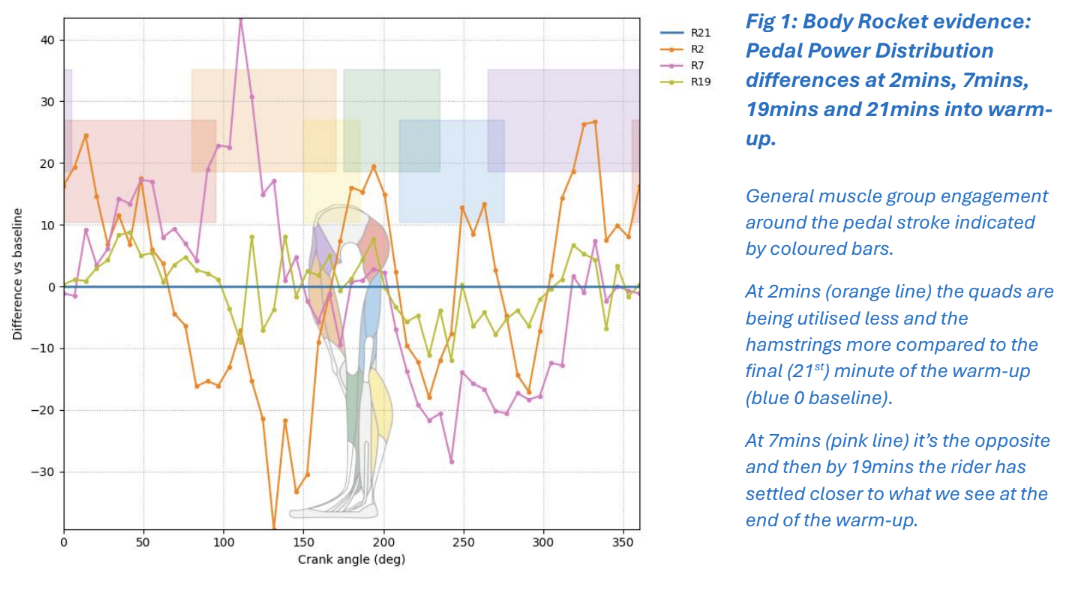
The reduction in hamstring stiffness noted in the sources correlates directly with shifts in force application. Body Rocket pedal sensors reveal that at approximately 7 minutes into a warm-up, there is a measurable change in power distribution. Specifically, the rider exhibits a greater contribution from the quadriceps and a decreased reliance on the hamstrings reflecting the muscle-tendon complex's increased compliance. Increasing stabilisation of the pedalling stroke took several minutes longer.
2.2. Pelvic Conformity and Saddle Position
Literature suggests that reduced stiffness allows for greater range of motion and joint kinematics. Body Rocket sensor data exemplifies this through saddlePosition metrics. In the first 6 minutes of exercise, riders typically
exhibit a significant positional shift, moving from an initially forward position to a stable position several centimetres further back on the saddle. This suggests that "cold" stiffness prevents the pelvis from naturally conforming to the saddle contour.

3. Validation of Neuromuscular Optimization
3.1. Postural Stability and Pitch Moment
While scientific studies use force platforms to show that warm-up improves postural control and reduces sway, Body Rocket sensors provide a cycling-specific equivalent via saddle pitch moment and lateral rocking. Data shows that pitch moment (tilting at the saddle tip) only begins to settle after roughly 6 minutes, corresponding to the point where the rider establishes a more stable, centred postural strategy.

3.2. Complexity and Weight Equilibrium
Advanced EMG analysis indicates that the neuromuscular system reaches an "optimized state" characterized by increased signal complexity after warm-up. Body Rocket's saddleWeight sensors provide a macro-level view of this optimization. Weight distribution on the saddle is highly volatile during the first phase of exercise
and only reaches a plateau after approximately 12 minutes. This "settling time" represents the transition from a stiff, uncoordinated state to the "informationally rich variability" associated with a healthy, warmed physiological state.

4. Conclusion: The Case for a 15-Minute Minimum
The Body Rocket sensor array provides empirical proof for the "biomechanical drift" predicted by exercise science. The system's ability to track saddle stability (SD position), which has been shown to decrease progressively for the first 10–12 minutes before plateauing, is critical for fit accuracy.
Hard Evidence Summary:
• 6 Minutes: Required to establish stable saddle position and reduce pitch moment volatility.
• 7 Minutes: Required for pedal power distribution to shift from a "stiff" hamstring-heavy strategy to a "warmed" quadriceps-efficient strategy.
• 12 Minutes: Required for total saddle weight distribution to achieve equilibrium.
Adjusting a bike position before these sensor-tracked plateaus occur risks fitting the rider to a transient state of stiffness rather than their true, steady-state athletic posture.


.png)