.png)
Introduction
Bike fitting aims to optimise rider comfort, performance, and injury mitigation through adjustment of position. Traditionally, these adjustments rely heavily on observational kinematics, rider feedback, and static angle measurements. However, growing evidence indicates that cycling biomechanics are strongly influenced by workload.
Incremental cycling studies demonstrate that joint kinematics and muscle activation patterns shift significantly above approximately 70% maximal aerobic power. Ref 1
Workload has also been shown to influence three-dimensional joint moments throughout
the lower-limb kinetic chain. Ref 2
These findings suggest that posture, stability, and coordination are not invariant across intensities.
Despite this, most fitting procedures lack the instrumentation required to quantify dynamic load redistribution across the contact interfaces (saddle, handlebars, pedals). Without direct measurement of forces and moments at these interfaces, changes in coordination strategy may remain undetected.
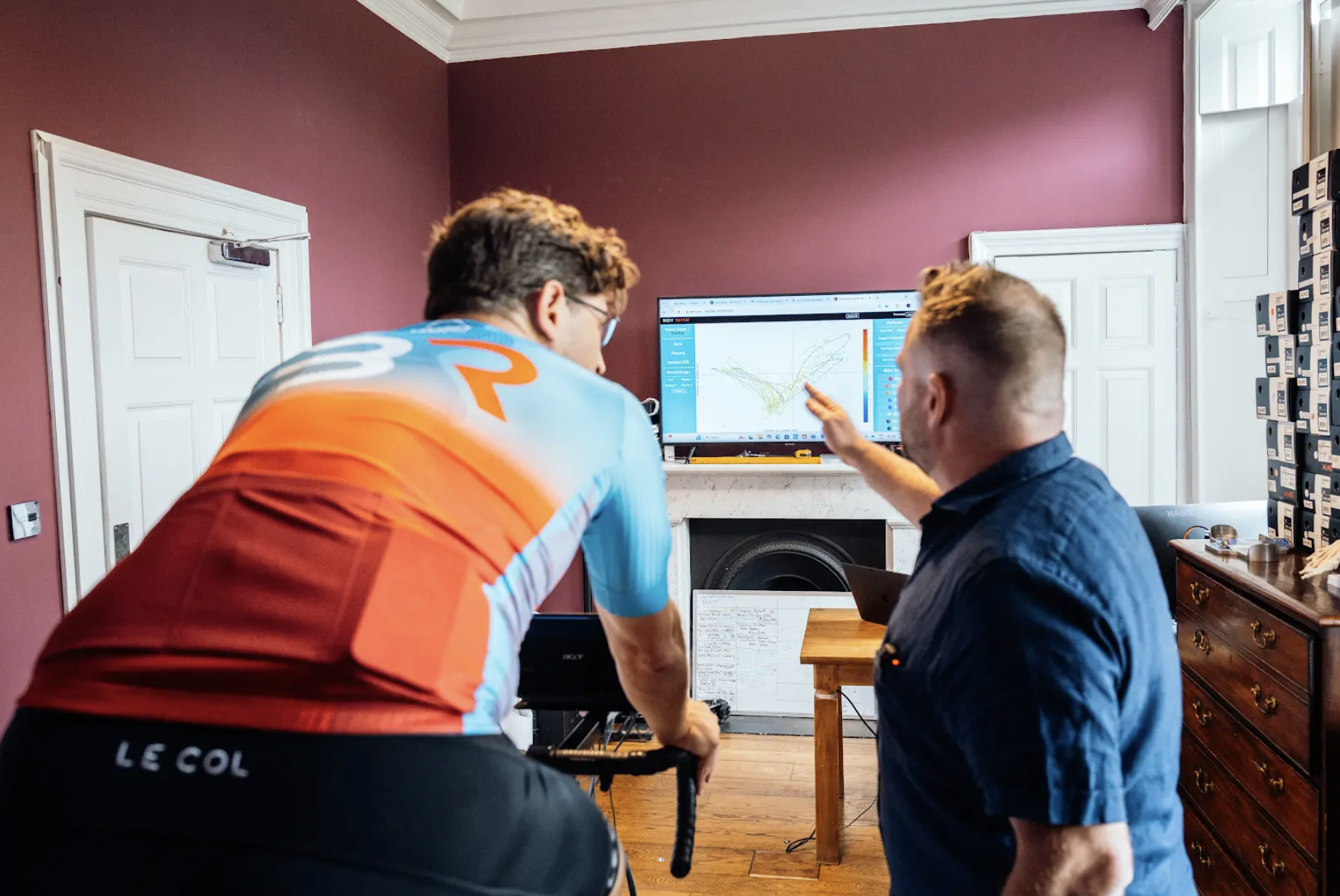
The Body Rocket FIT+ system provides continuous measurement of:
- Bilateral saddle load and pitching moment
- Handlebar load
- Pedal force characteristics (tangential and radial components)
- Derived coordination metrics (smoothness, torque effectiveness)
This enables objective detection of mechanical shifts that would not be observable through kinematics alone.
Hypothesis:
Power output will induce systematic, measurable changes in pelvic mechanics and pedalling coordination, and continuous multi-point load measurement will allow identification of an intensity range most representative of performance posture.
Methods
Study Design
A repeated-measures incremental protocol was conducted under controlled laboratory conditions. The rider maintained a fixed bicycle configuration throughout all trials.
Power Conditions
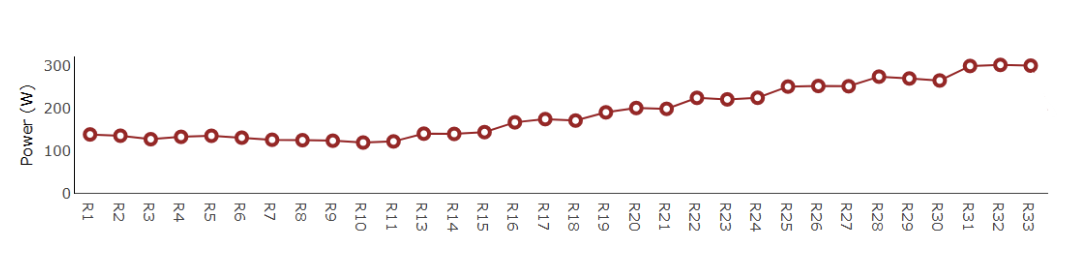
Nine discrete power outputs were tested:
100 W, 125 W, 150 W, 175 W, 200 W, 225 W, 250 W, 275 W, and 300 W.
Cadence was maintained within a consistent target range throughout.
At each condition:
- Three steady-state recordings were captured.
- A selection of intervals were analysed.
Metrics Analysed
Pelvic and load distribution:
- Saddle position standard deviation (SD)
- Lateral rocking magnitude
- Left–right saddle balance
- Pelvic twist angle
- Weight distribution (saddle, handlebar, pedals)
Pedalling metrics:
- Pedal offset
- Pedal smoothness
- Torque effectiveness (TE)
All measurements were synchronised and analysed during steady-state pedalling at each power condition.
Results
Pelvic Position Stability
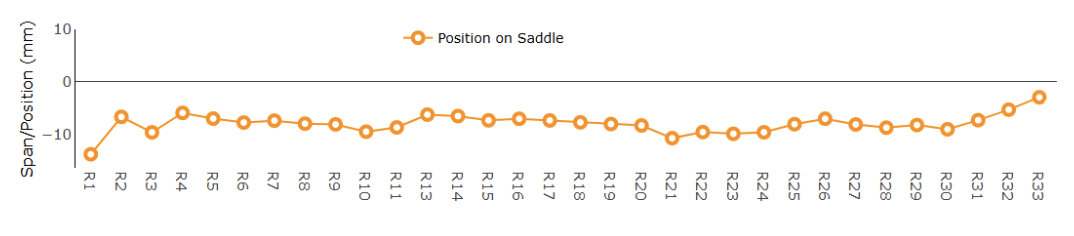
The rider’s fore/aft saddle position showed minimal variation across intensities after warming-up (R1-R5), although there was a shift forward on the saddle at the highest power (300w).
Lateral Rocking
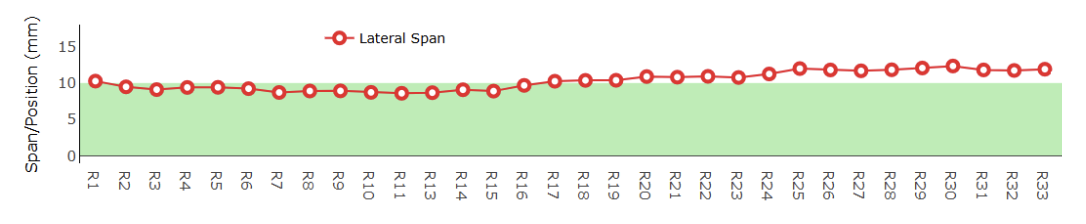
Lateral pelvic span increased progressively with power. This likely reflects increasing frontal-plane joint moments and hip stabilisation demands, consistent with previously reported 3D joint moment increases under higher workload.
Left–Right Saddle Balance
As power increased, saddle loading became more symmetrical between limbs. This may reflect improved bilateral neuromuscular recruitment, consistent with intensity-dependent increases in EMG amplitude reported in incremental protocols.

Pelvic Twist Angle
Pelvic twist decreased at higher powers, indicating reduced transverse-plane variability. This finding aligns with reported reductions in hip internal/external ROM at elevated intensities.

Load Redistribution
With increasing power:
- Saddle load proportion decreased.
- Handlebar load proportion decreased.
- Pedal load proportion increased.

This shift reflects expected redistribution of mechanical demand as crank torque increases.
Pedalling Coordination
Both pedal smoothness and TE increased progressively with power. Improvements became more consistent above approximately 70% of estimated threshold power. This is consistent with literature showing linear increases in EMG RMS amplitude with intensity.
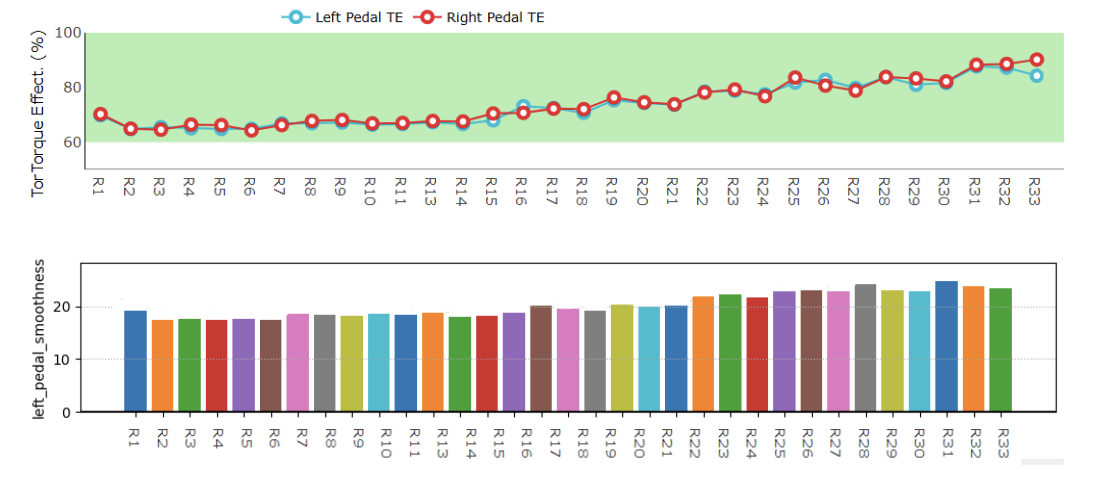
Identification of a Stabilisation Zone
Across multiple variables, behavioural stabilisation occurred between approximately 70–85% of threshold power. Below this range:
- Greater asymmetry was observed.
- Pedal smoothness was reduced.
- Twist variability was higher.
Above this range:
- Lateral rocking increased further.
- Fatigue-related distortions may begin to influence coordination.
Discussion
This investigation demonstrates that cycling biomechanics are intensity-dependent and that these changes manifest at the contact interfaces between rider and bicycle.
The progressive reduction in saddle load and pitching moment, combined with increases in torque effectiveness and smoothness, indicate that riders adopt a mechanically distinct strategy as power increases. These changes likely reflect enhanced neuromuscular recruitment and redistribution of force toward the crank system, consistent with previously reported EMG findings ref 2
Importantly, the magnitude of several observed changes was modest in absolute terms but consistent across increments. Such changes would be difficult to identify using visual posture assessment or static angle measurements alone.
Continuous load-cell measurement provides several advantages:
1. Objective quantification of load redistribution
The system directly measures shifts in support between saddle, bars, and pedals.
2. Detection of coordination improvements
TE and smoothness provide functional insight into how force is applied.
3. Identification of stabilisation thresholds
By observing plateau behaviour in multiple variables, a fitting intensity window can be determined empirically rather than heuristically.
This capability transforms bike fitting from a largely observational process to a quantifiable, repeatable biomechanical assessment.
Practical Implications
The findings indicate that fitting at low intensities (<50% FTP) may misrepresent:
- Load distribution characteristics
- Pelvic stability
- Functional pedalling coordination
Conversely, extremely high intensities may introduce fatigue-related distortions.
Using continuous quantitative feedback, the present study identified a stabilisation region at approximately 70–85% FTP, where:
1. Load redistribution appears representative of performance demand
2. TE and smoothness plateau
3. Pelvic behaviour becomes consistent
The ability to detect these transitions in real time provides the fitter with:
- Objective confirmation of biomechanical state
- Quantitative endpoints for adjustment decisions
- Reduced reliance on subjective rider perception
Thus, the value of the measurement system lies not in replacing fitting expertise, but in augmenting it with repeatable mechanical evidence.
Conclusion
Cycling biomechanics are power-dependent, and meaningful shifts occur in pelvic mechanics and pedalling coordination as intensity increases.
Critically, these shifts are measurable only through continuous, multi-point load instrumentation. The ability to quantify saddle moments, contact load redistribution, and
force application characteristics enables identification of an empirically justified intensity range for dynamic fitting.
Dynamic bike fitting is therefore recommended at approximately 70–85% FTP, as determined through objective load-based stabilisation rather than visual estimation alone.
References:
1. Pouliquen C, Nicolas G, Bideau B and Bideau N (2021) Impact of Power Output on Muscle Activation and 3D Kinematics During an Incremental Test to Exhaustion in Professional Cyclists. Front. Sports Act. Living 2:516911. doi: 10.3389/fspor.2020.516911
2. Martín-Sosa E, Mayo J and Ojeda J (2025) Effects of workload on 3D joint moments in cycling and their implications for injury prevention. Front. Bioeng. Biotechnol. 13:1657558. doi: 10.3389/fbioe.2025.1657558
.png)